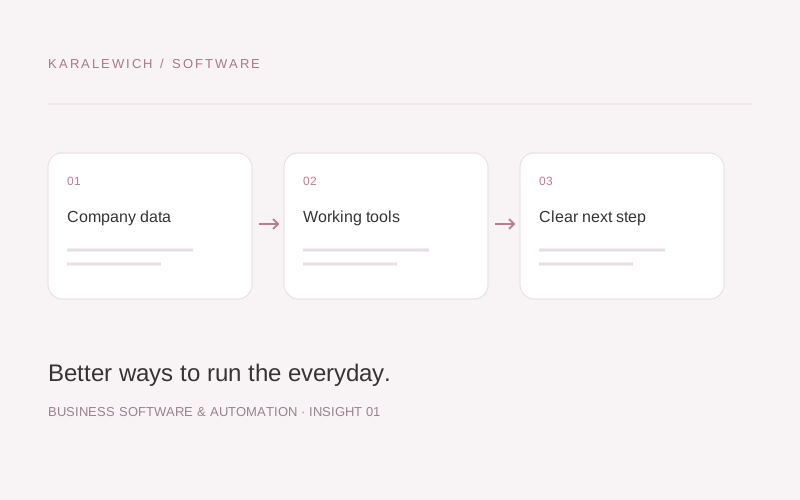
How to recognize when shared spreadsheets need clearer records, ownership, and workflows.
Look for the work around the file
A spreadsheet can be an excellent working tool. The difficulty starts when several people need different versions of the same customer, quote, or job record. Someone copies a row into another file, another person changes the status, and the team needs a conversation to establish which information is current.
The signal is usually the surrounding effort: checking versions, rebuilding reports, protecting formulas, or asking who last changed a record. Adding another tab may make the sheet larger without resolving those questions.
Map one record from start to finish
Choose a familiar record, such as a quote. List the information it contains, who creates it, who approves it, and what happens after it is sent. Note where the same details are entered again. That exercise describes the application more usefully than a long feature wishlist.
A database-backed application can give each record an identity, a clear owner, and a controlled set of steps. The spreadsheet may still remain useful for analysis or exports; it does not have to disappear from every part of the business.
Start with a contained improvement
Select one shared process with recurring friction. Agree what a better working day would look like, then review a small working version with the people doing the task. The aim is a dependable process that earns its place, rather than a large system assembled around every possible feature.